Posthuman Poetics
Friday, August 4, 2023
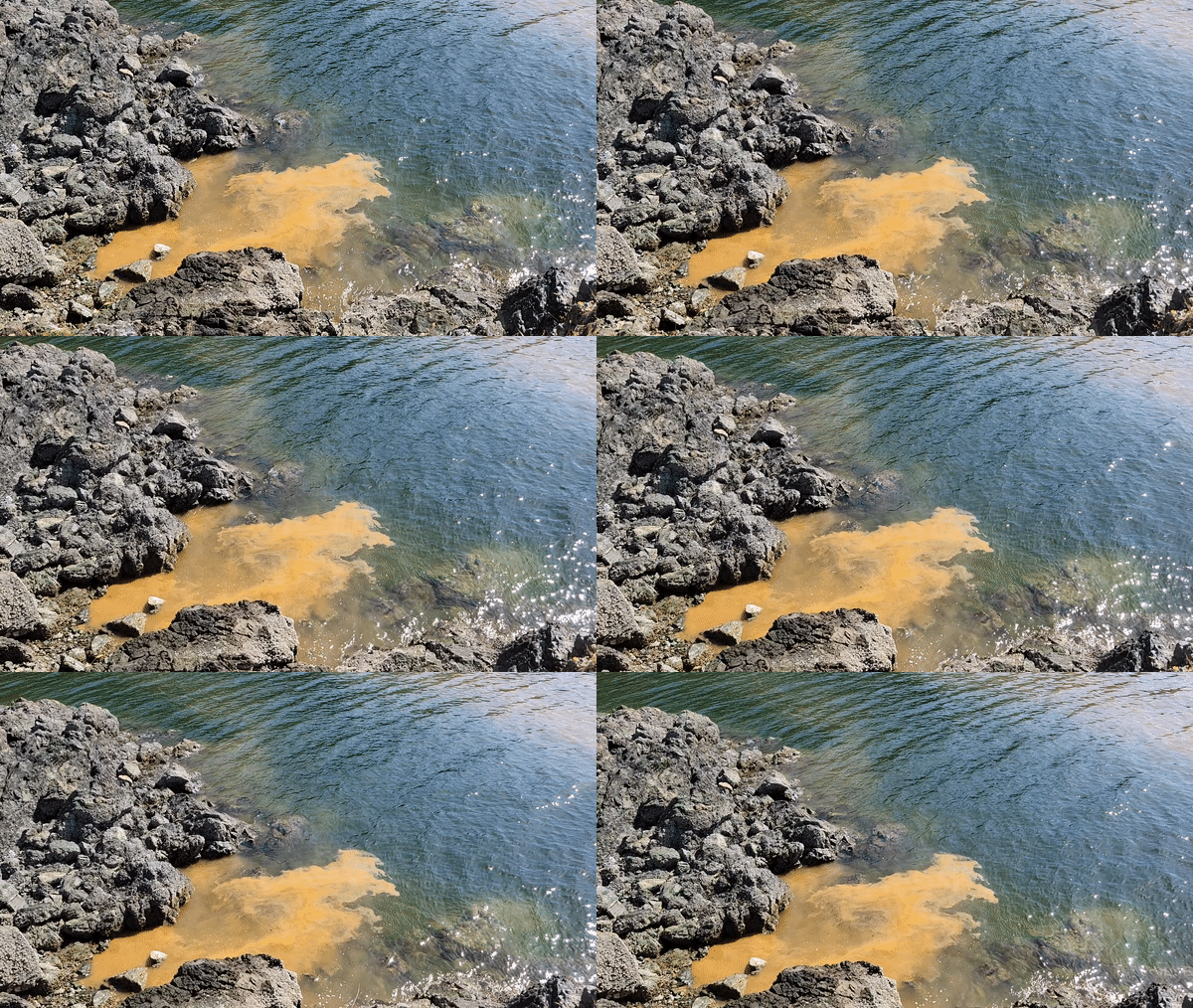
If an excess “red tide” (noctiluca scintillans) is the product of the capitalocene, in this case are we able to speak of a “posthuman poetics” insofar as the second term signals productive capacity (from the Greek poiēsis)?
What are the contours of a “posthuman poetics”? While the last 20 years have seen the emergence of what Richard Grusin calls the “nonhuman turn”, as distinguished from the twentieth century’s “linguistic turn” (Grusin, xv), moving towards a posthuman ethics and epistemology, some (Yussoff, Bennett, Wolfe, Povinelli, amongst others) working in the field have sought to imagine what a “posthuman poetics” might look like. Yet poetics themselves have, since the nineteenth century at least, attempted to think in “posthuman” terms. If for Arthur Rimbaud, that key figure of Symbolist poetry, the “I” is an “other” (“Je est un autre”) and language speaks through him: “one speaks me” (“on me parle”), then the modernist poetics of impersonality (or depersonalisation) that breaks with classical conceptions via dissonance and dislocation, might constitute a type of posthuman poetics. That is, human language, the very thing that traditionally distinguishes the human from the nonhuman, is not so human after all, insofar as it speaks itself through us.
This notion of language as autonomous or self-generating manifested itself in the poststructuralist idea of intertextuality, for instance; and thinkers such as Julia Kristeva and Henri Meschonnic went far to examine the embodied nature of signification. Genealogies of the posthuman aside — for example, one can draw such a genealogy from Rimbaud and Stéphane Mallarmé to Kristeva to Judith Butler to Karen Barad and beyond: from the decadent poet to multispecies co-creation, or “sympoesis” (Haraway) —, if we ask what are the contours of a “posthuman poetics”, we must examine poetics in a new light. If poetics is about the human potential for producing, and if this very thing that distinguishes us from the nonhuman is put in question, insofar as our productive potential is much more nonhuman than the philosophical tradition has cared to admit, what are the aspects to poetics that must be considered in light of a posthuman epistemology and, more importantly, a posthuman ethics and politics, where a subject-object and instrumental logics have been increasingly contested?
Any contours of a “posthuman poetics” must consider therefore what Rosi Braidotti describes as “post-human subjects of knowledge — embedded, embodied and yet flowing in a web of relations with human and non-human others”.
The Summer of Theory, an annual symposium that has taken place at the University of Victoria since 2018, has gathered artists, researchers, and researcher creators in order to think about various topics around theory, play, creativity, animality etc. This symposium gathers attendants from the community (both academic and nonacademic), from across Canada, and internationally (Poland, France, Brazil, New Zealand, U.S.A.) in order to think about theoretical and artistic concepts concerning preoccupations around politics, society and culture. This highly interdisciplinary and transdisciplinary context allows for a fecund workshopping of ideas, and is an ideal space for elaborating a “posthuman poetics”.
References
- Braidotti, Rosi. “A Theoretical Framework for the Critical Posthumanities” (2019) 36(6) Theory, Culture & Society 32–33.
- Grusin, Richard. The Nonhuman Turn. Minneapolis: University of Minnesota Press, 2015.
 seismopoetics