In person:
- David Gifford: Pssst-pffft
- Pierre-Luc Landry: La phrase de Rilke: A Metamorph on Mount Tolmie, and Other Stories
- Leah McInnis: The best thing I found was a piece of plastic
- Loumille Métros: Post-prandial
- Frances Wear: Against Fusion: On Difference and the Poetics of Solidarity in Schelling’s Freiheitsschrift and H.D.’s Sea Garden
- Mark Zion: Literalising the ‘Posthuman’ with Annihilatory Poetics: Melancholia’s Effective Affective Apocalypse
David Gifford: Pssst-pffft
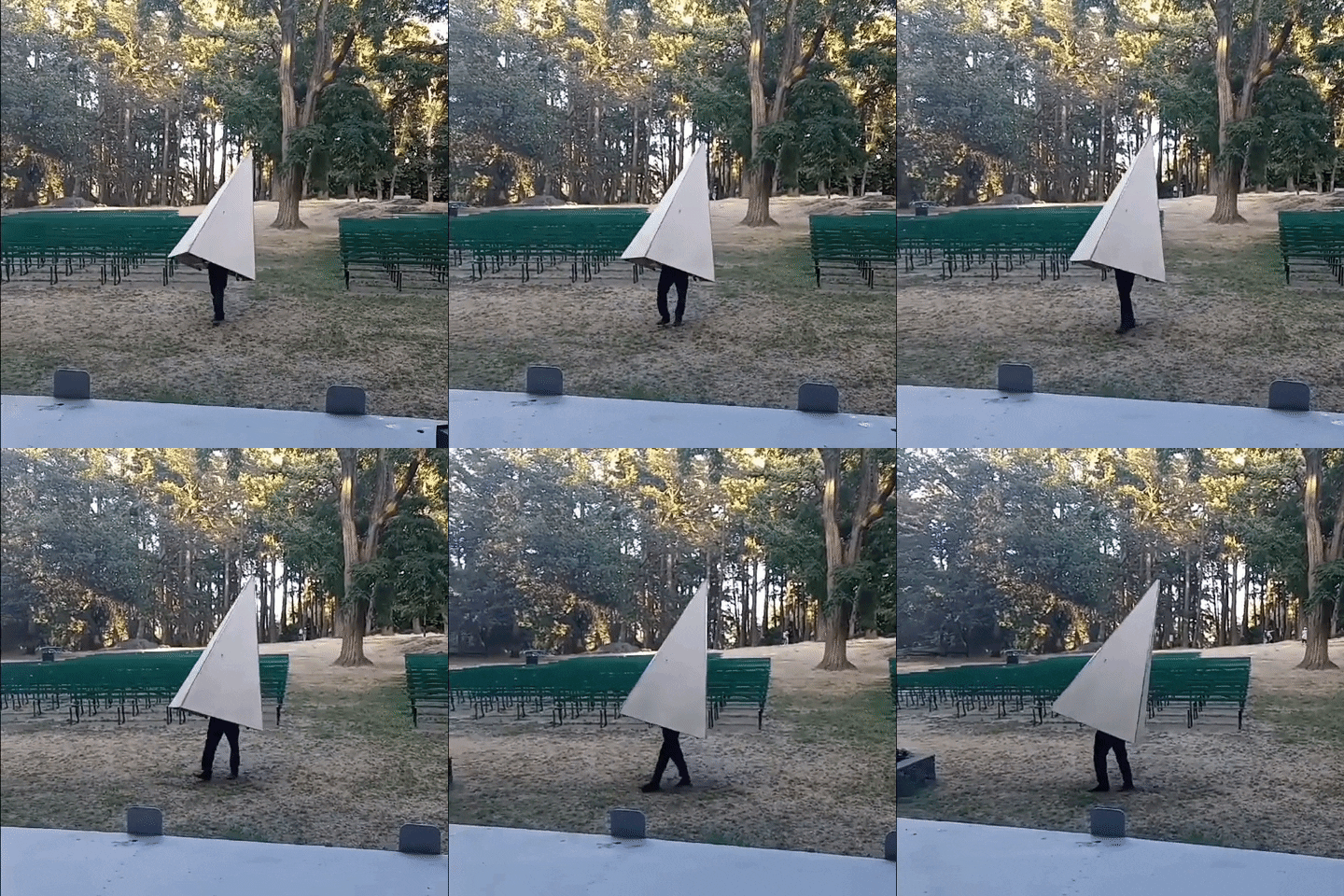
Clever and Pleasant Inventions. A selected demonstration of studied mysteries interpreted from the text ‘Clever and Pleasant Inventions’, 1548, “Containing Numerous Games of Recreation and Feats of Agility, by Which One May Discover the Trickery of Jugglers and Charlatans. Composed by J. Prevost, native of Toulouse.”
David Gifford is a magician, colour theorist, art educator, noise artist and builder of causality assembly machines in his backyard. In these machines he finds expressions of drawing and poetry and experiences joy in putting to work his collection of objects and broken tools.
Pierre-Luc Landry: La phrase de Rilke: A Metamorph on Mount Tolmie, and Other Stories
Delivery mode: in-person (meatspace)
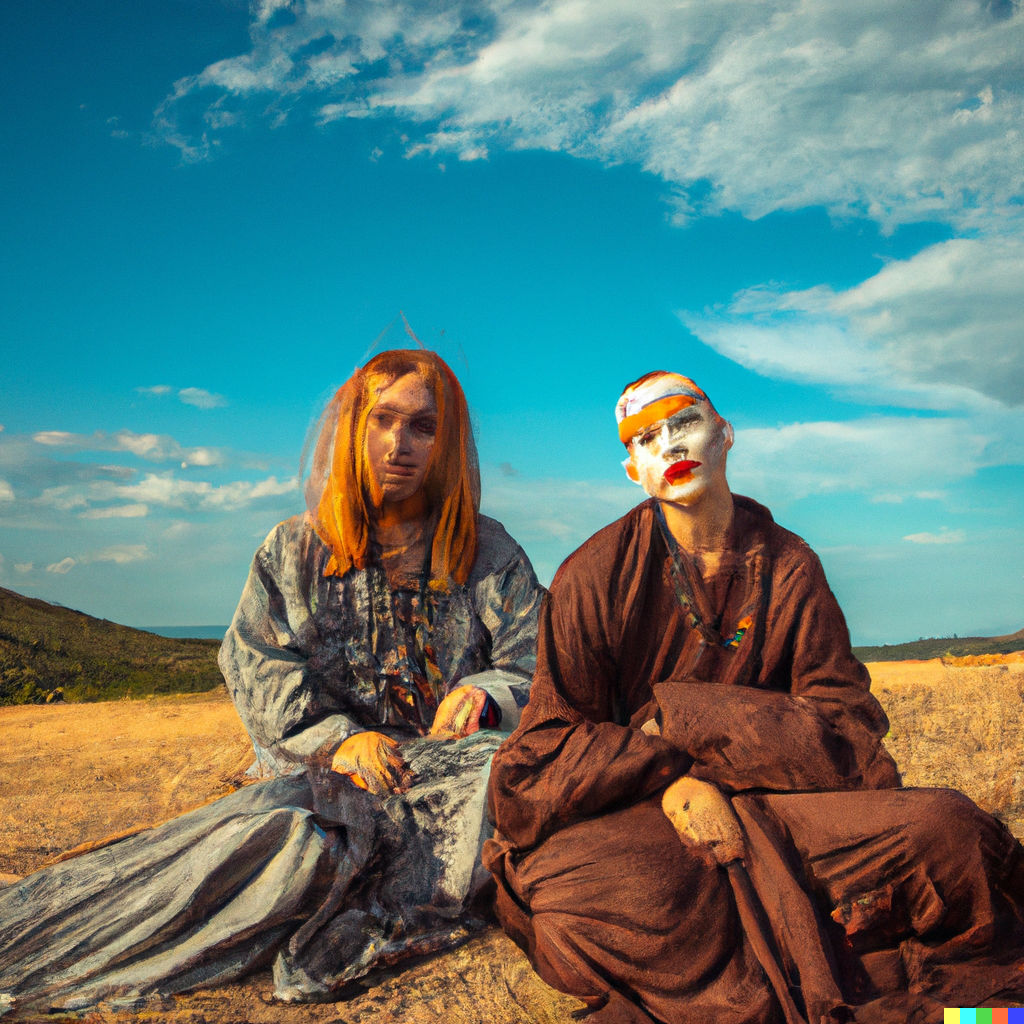
My proposal—La phrase de Rilke—will be a long hybrid, narrative poem, a performance, built on nothing and everything all at once, pieces of this and that: a trajectory, A Map to the Door of No Return, to borrow from Dionne Brand’s 2001 notes on belonging.
Starting point—an aphorism written by Rainer Maria Rilke in his Book of Hours (1905): “Let everything happen to you: beauty and terror / Just keep going. No feeling is final.”
First stop—Mount Tolmie, a phantasmatic time and place, un lieu anthropologique, a true confabulation. A Metamorph sitting on top of the hill writes a letter to Vancouver Island, an other-than-human friend, in the Buddhist environmental writing tradition of Japanese Shingon monk Myōe (1173–1232). I’ll be rereading theories developed by Buddhist neuropsychologist Rick Hanson in his book Hardwiring Happiness. A moment of radical, posthuman self-care.
Second stop—the Salish country, deterritorialized yet extremely present and identifiable on the field. When I arrived in Victoria in 2019, I was welcomed by Elders and knowledge keepers from the Gulf Island nations, including Qwul’sih’yah’maht Robina Thomas, a member of the Lyackson First Nation, and these teachings have guided me for four years now1. I’ll retell the story of my first and only meeting with Lee Maracle, a writer from the Stó:lō nation, when I was ready to quit, and how reading her Conversations With Canadians, many years later, gave me the power to keep on keeping on: “The wandering life, picking up knowledge, experiences, testing our theories—this is the work of the wandering life. Filling our baskets with knowing, studying phenomena, engaging in relationships, failing, learning from our failures, re-evaluating ourselves, and beginning anew.”
Third stop—the kitchen countertop. Weed and music, late at night. Intérieur nuit. A drag queen lies on her back and lipsyncs to Elle King’s rendition of My Neck, My Back: “Right now, lick it good / Lick this pussy just like you should.” Auto-expérimentation: this “self-technology at the heart of a dystopian society” (Preciado, Testo-Junkie). Je suis de la fucking bombe. I’ll explore how chromonormativity and my queer existence transformed me, at 38, into an Auntie. c’est vrai je m’attache un peu trop au souvenir d’une jeunesse fabulée / il est trop tard j’arrive et c’est déjà terminé / je veux une maison dans toutes les pièces il faut danser.
Last stop—Emanuele Coccia, italian philosopher, professor at the École des Hautes Études en Sciences Sociales. In order to think all that is queer in phenomena otherwise considered as “natural”—looking at the world as a whole, beyond the anthropomorphic and binary norms of compulsive heterosexuality, beyond speciocentric humanism: post/ab/trans.
Pierre-Luc Landry, Assistant Professor Department of French and Francophone Studies University of Victoria. pierreluclandry@uvic.ca
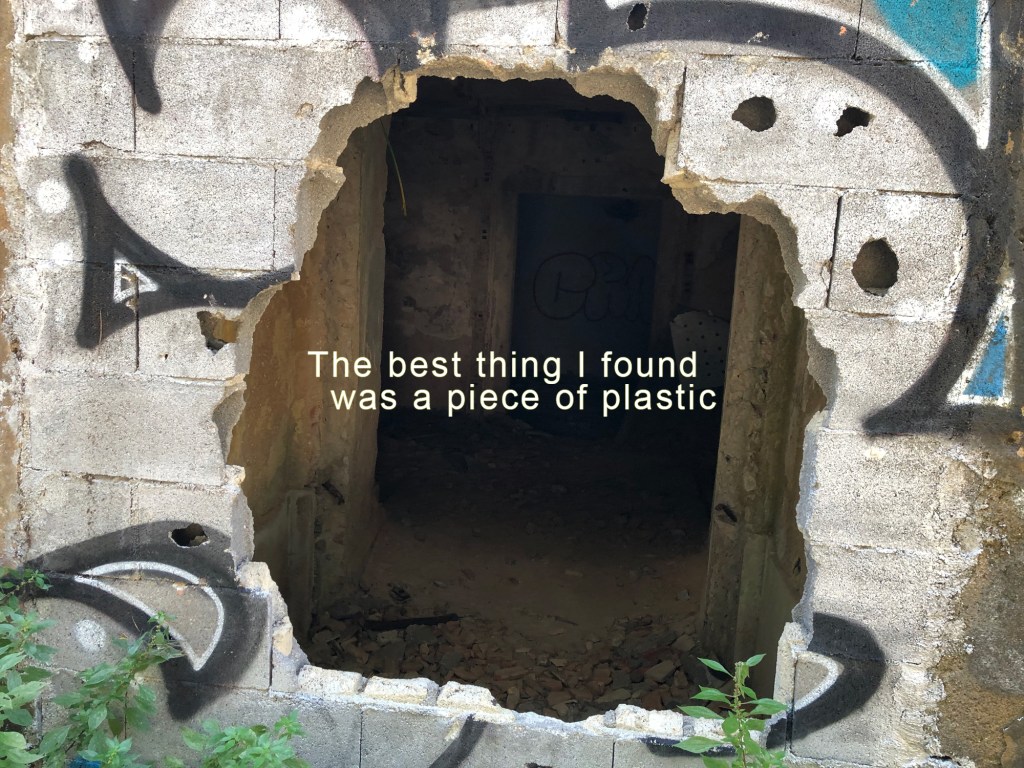
Leah McInnis: The best thing I found was a piece of plastic
Dirt bikes, weed eaters, barking dogs, shrieking children.
Tiny pearls of styrofoam stick to my knees after I stand up.
Afraid to go inside, so I resort to flash photography.
Angry when an orange sundress enters the frame, but glad when an ant walks by.
Are they not the same?
Bugs.
Using 5ª Bateria da Raposeira in Trafaria, Portugal, as its location, and a series of small sculptures as its cast of characters, The best thing I found was a piece of plastic, presents a narrative told in nine parts with an original score. Considering that we are all, as Rosi Braidotti says, collaboratively linked to a web of human and non-human agents, this new video work examines textural histories of asserting dominance, failure, and aesthetic betrayal.
Leah McInnis (she/her) is an conceptual artist currently living in Victoria, BC on the traditional territory of the Lekwungen speaking-peoples.
Loumille Métros: Post-prandial
“Noon slumbers. Kevin Egan rolls gunpowder cigarettes through fingers smeared with printer’s ink, sipping his green fairy as Patrice his white. About us gobblers fork spiced beans down their gullets. Un demi setier! A jet of coffee steam from the burnished caldron. She serves me at his beck. Il est irlandais. Hollandais? Non fromage. Deux irlandais, nous, Irlande, vous savez? Ah, oui! She thought you wanted a cheese hollandais. Your postprandial, do you know that word? Postprandial. There was a fellow I knew once in Barcelona, queer fellow, used to call it his postprandial. Well: slainte! Around the slabbed tables the tangle of wined breaths and grumbling gorges. His breath hangs over our saucestained plates, the green fairy’s fang thrusting between his lips. Of Ireland, the Dalcassians, of hopes, conspiracies, of Arthur Griffith now.”
James Joyce, Ulysses, ch 3 (“Proteus”)
Loumille Métros’ book, Taunting the Useful, will come out some time soon this summer.
Frances Wear: Against Fusion: On Difference and the Poetics of Solidarity in Schelling’s Freiheitsschrift and H.D.’s Sea Garden

In their assaults against anthropocentrism, key theorists of the “nonhuman turn” frequently seek to eliminate a distinction between nonhumans and humans (Bennett, Braidotti, et al.). However, this sort of theorizing curtails the ethical demands that many such theorists rightly place upon humans. That is, such accounts maintain otherness as a problem to be overcome, not a state to respect as otherness, resulting in no more than the subject colonizing the object.
Against this predominant subsumption of otherness, I use idealist philosopher F. W. J. von Schelling’s Freiheitsschrift (1809) and modernist poet H.D.’s Sea Garden (1916) to assert that there is a salient difference between humans and other species. With Schelling I use the origin of this difference—the struggle endemic to life as such—to unseat the metaphysics of fusion theories. With H.D. I turn Schellingian difference into a poetics of doomed but meaningful interspecies solidarity against ‘another other’: positive entropy.
Works Cited
- Bennett, Jane. Vibrant Matter: A Political Ecology of Things. Duke University Press, 2010.
- Braidotti, Rosi. “A Theoretical Framework for the Critical Posthumanities.” Theory, Culture & Society, vol. 36, no. 6, 2019, pp. 31–61, https://doi.org/10.1177/0263276418771486.
Frances Wear is an MA student in English and CSPT at UVic. franceswear@uvic.ca
Mark Zion: Literalising the ‘Posthuman’ with Annihilatory Poetics: Melancholia’s Effective Affective Apocalypse
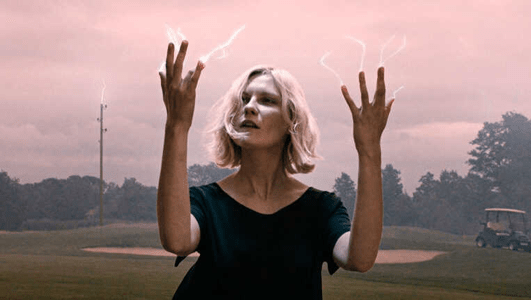
In Lars von Trier’s Melancholia (2011), the literal end of the planet dramatizes the contingency of structures that appear ironclad at the outset: capitalism and the bourgeois nuclear family form. Ironically, the device of apocalypse might allow us to put in question those structures, which are themselves world-ending, albeit with no punctual end anticipated within biographical time. The film adopts a cosmological as well as a depressive’s perspective (via Justine, or importantly, ‘aunt Steelbreaker’) in order to render contingent the ruthless naturalisation of the dominant planetary anti-relational onto-epistemology. As in Jean Pierre Dupuy’s ‘enlightened catastrophism,’ the film’s ending with the end of the world interrupts the otherwise ‘slow violence’ of the Capitalocene (or whatever -cene/scene one prefers). But rather than offering any exercise of logical pedantry, ex cathedra, with respect to rational responses to planetary dysfunction, our guide will be affect. Freud held that it is the depressive who has the greatest insight into reality, and we will map the relation between Justine’s melancholia (and it’s gradual inversion) and the arrival of Melancholia, as well as the affective polarity the film constructs between her and her initially ‘well-adapted’ sister, Claire. What are the costs of being well-adapted to injustice? What ‘ugly feelings’ (Ngai) could open the way, through discomfort, to revolutionary imagination? Can that sort of imagination be more than a mere prerequisite for revolutionary transformation (even if it may be that too)?
Mark Zion is a PhD candidate and Instructor in the Faculty of Law. An anti-Zionist, anti-credentialist,* anti-nomian, his Deleuzian ‘line of flight’ from theory-amnesiac careerist avowals of immutable ‘identity’ has now taken him somewhere beyond the solar system, where he pre-emptively seeks Melancholia. He looks forward to the SOT5 gathering but regrets having to drop his Po-etic idea (“Fall of the House of Usher”), a darling that, like the antagonist’s sister, he apparently could not kill. *This is not to suggest he is not dying to bag this fugitive credential.
 seismopoetics