Participants
Hélène Cazes — Song for a Season of Stillness
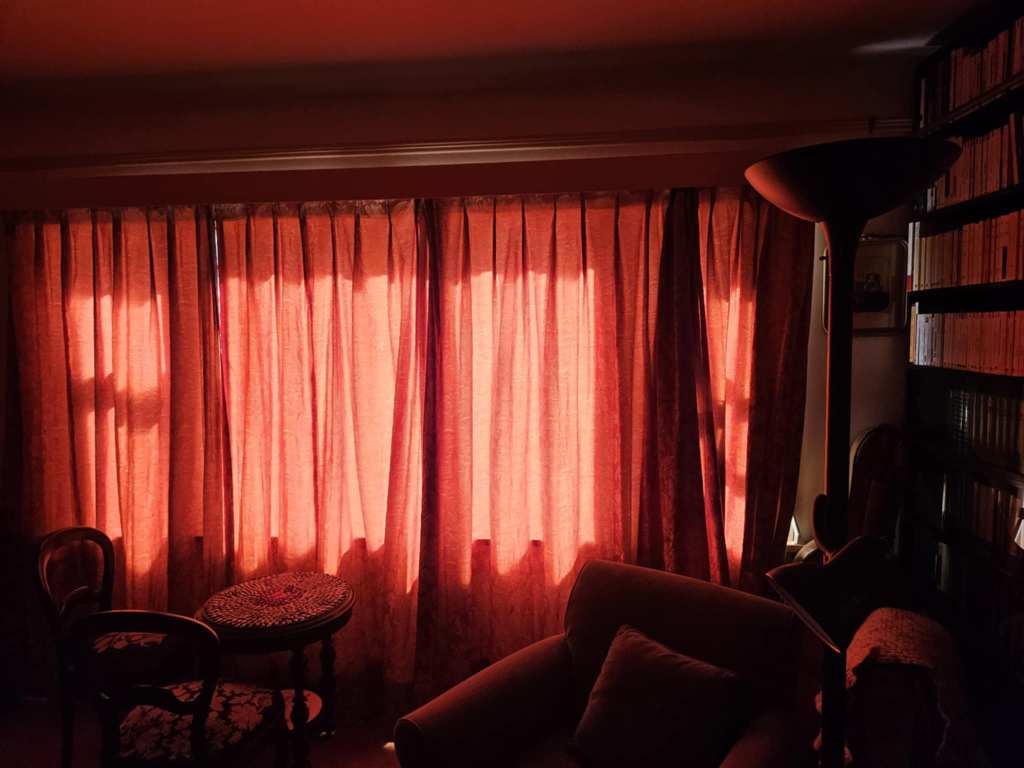
Songs for seasonal stillness is anything but still. The Pea likes to jump from a topic to another, from medieval medicine to Russian fairy tales, and the Doctor Princess cannot refrain from documenting over and over. Transitions are abrupt when not ludicrous, bibliography is personal and unverifiable, format is fanciful etc. Both presenters were inspired by the question and grateful to be accepted. The Pea will be dancing and singing, inviting guest speakers too (unfortunately, this is purely intra-cerebral, hence does not provide a good show). The Princess will read the script and play the slides, acknowledging the others’ parts when possible. Be prepared for turning wheels, roaming snowed-in forests, peeking at gentle giants, imagining choirs’ advice, avoiding the sight of medieval genitals, commenting on the dress worn by Christine of Pizan, and spending a few minutes with a très riche heure (although the Duke of Berry will not attend in person).
Dr. Hélène Cazes (and her Pea) has trained and taught in many places ( see https://onlineacademiccommunity.uvic.ca/helenecazes/ about many happy, studious years in the learned company of Classics, humanists, poets, students, and computers.) Then came 2022, when she met a young, persistent, demanding Pea, who mistook her for a Princess and settled in her memory palace. She is now enjoying a adventurous life away from academic positions and offices, sometimes calling the Pea Atticus. The Pea himself is too young to have a bio. SOT 25 is their first joint contribution to a University event. And only SOT could it be.
Anthony Gavin — Where’s W(y)nter? Restor(y)ing the Humanities in an Age of AI-Induced Psychosis
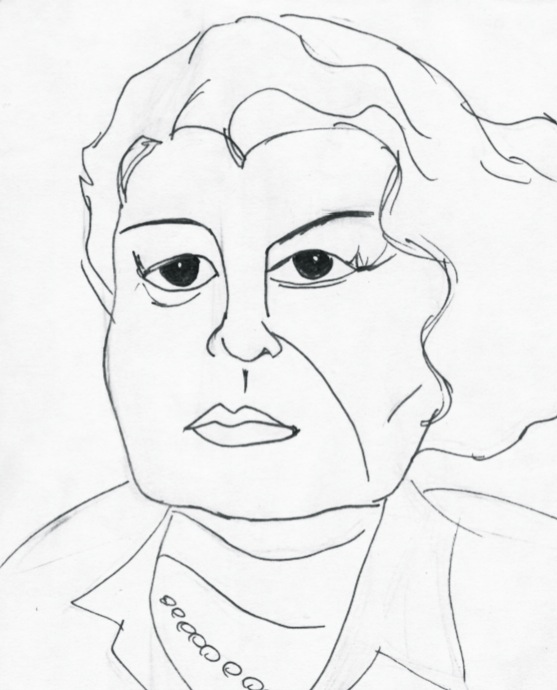
Since the rise of generative artificial intelligence (genAI), tech gurus and clickbait columnists have continually proclaimed the death of higher education—and the Humanities in particular (Illing; Walsh). While genAI may act as an accelerant, debates about a crisis in the Humanities are nothing new. In the 1960s, such debates centered around the rift between the Humanities and STEM-disciplines (Snow); then in the 1970s-80s, the so-called “canon wars” saw the Humanities struggle to retain their internal coherence and universal value. Sylvia Wynter’s scholarship during this period strikes a remarkable balance between a foundational criticism of normative humanism and a generative refusal to abandon humanism as a universalist project (Wynter; Rodriguez). The recent eagerness to eulogize the Humanities and higher education makes Wynter’s call for a new humanist revolution in the twenty-first century seem all the more prescient. I respond to Wynter’s call through my own methodological conceit of “restor(y)ing”—that is, by reflecting on how to restore the Humanities’ value by re-storying human-oriented praxis in an age of posthuman technoscience.
References:
- Illing, Sean. “Is ChatGPT Killing Higher Education?” Vox, 5 Jul. 2025, https://www.vox.com/the-gray-area/418793/chatgpt-claude-ai-higher-education-cheating.
- Rodriguez, Anthony Bayani. “Introduction: On Sylvia Wynter and the Urgency of a New Humanist Revolution in the Twenty-First Century.” American Quarterly, vol. 70, no. 4, 2018, pp. 831–36. Crossref, https://doi.org/10.1353/aq.2018.0065.
- Snow, C. P. The Two Cultures and the Scientific Revolution. Cambridge University Press, 1959.
- Walsh, James D. “Everyone Is Cheating Their Way Through College.” Intelligencer, 7 May 2025, https://nymag.com/intelligencer/article/openai-chatgpt-ai-cheating-education-college-students-school.html.
- Wynter, Sylvia. “The Ceremony Must Be Found: After Humanism.” Boundary 2, vol. 12, no. 3, 1984, p. 19. Crossref, https://doi.org/10.2307/302808.
David Gifford
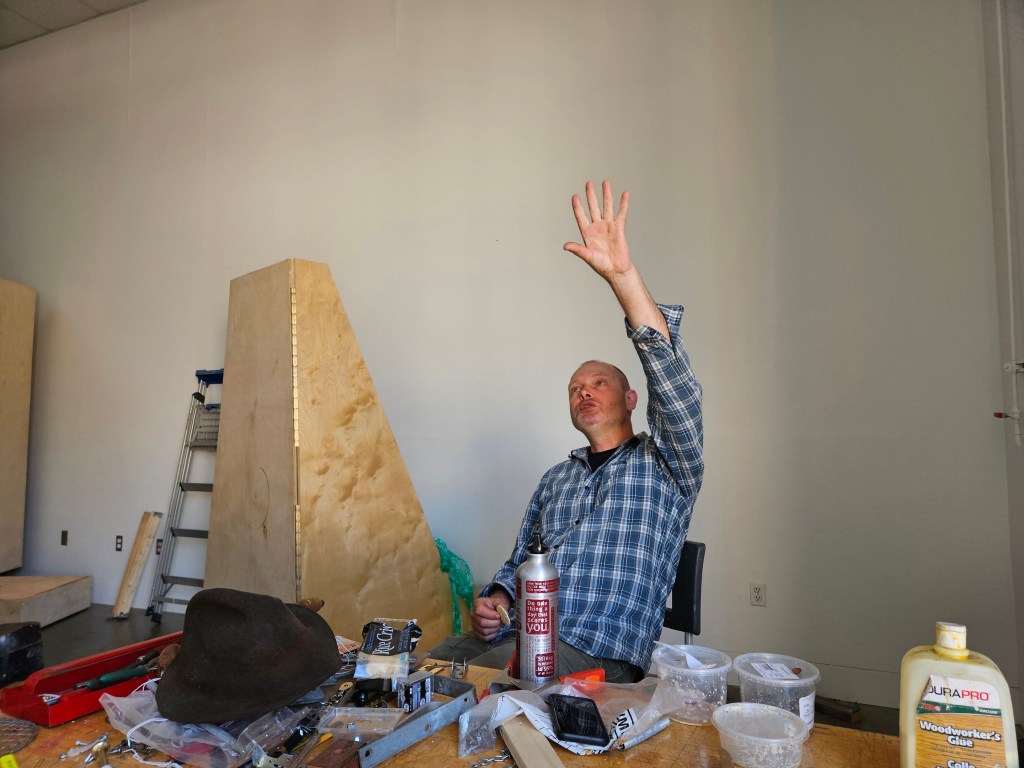
Rube-Goldberg would be proud of this noïse-making magician whose screeching mechanisms devour the soundscape of a thousand tiled metaphors. In the forest, by the sea, on the cold, dark mountain in the rains of December, the red light of walking intonations and meditations provide the backdrop of what might be a close call. Nevertheless, this noïse magician swerves deftly by keeping a distance from the oncoming headlights, wielding his ebike at Promethian speeds in a cascade of calculated consequences — logically implied in “something for nothing.”
Leah McInnis — Assemblage Cookbook
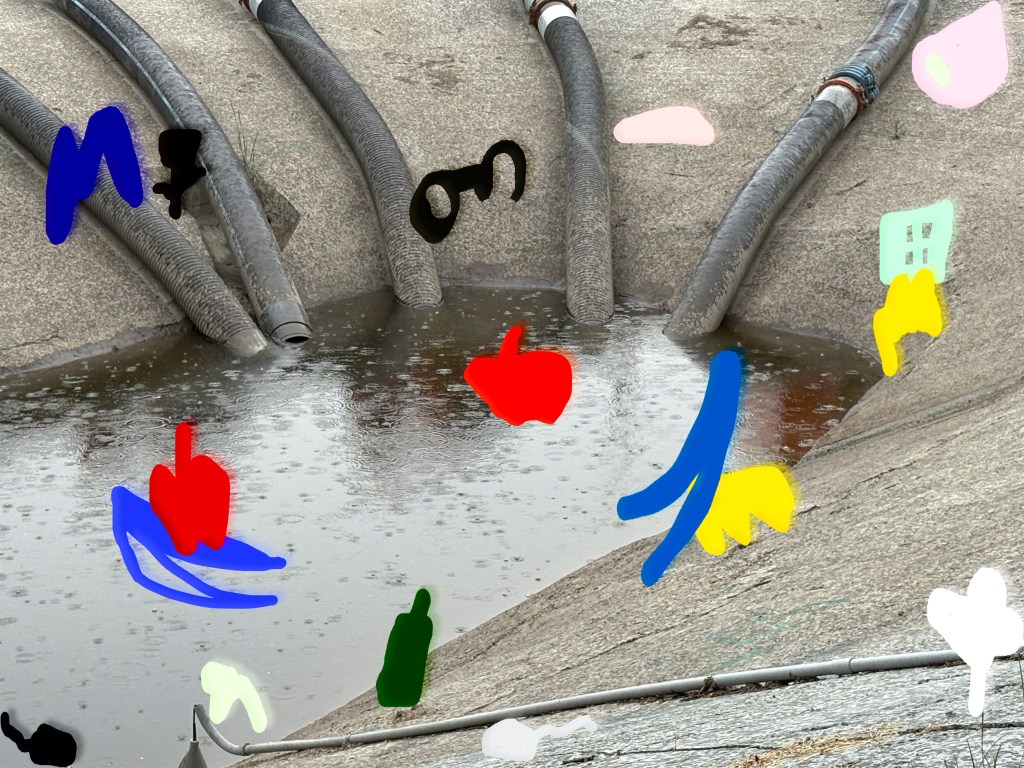
Are we cooked? Fires, floods, and droughts occur alongside appeals to petro-nationalism amidst rising costs of daily life. Current events prompt the question: what is happening? Perhaps a more useful inquiry is: how could this ever come to be? Actor-network theory brought me to affect theory and then I landed on a plateau within Deleuze and Guattari’s Geology of Morals. Can thinking of current ecological/political/social conditions as relational assemblages lead us out of the kitchen and into the dining hall of solutions?
Assemblage Cookbook is a collection of captioned photography in zine format that seeks to excavate understanding. Influenced by Johan Huizinga’s theory of play, this project offers recipes for meandering sense-making that map my own connections to petroculture, just energy transitions, and the potential of art to create new worlds.
Loumille Métros — Absolute Cold

The planet warms, but the universal or absolute cold is waiting. If people of the Poles seek ways to avoid cold, those of the equator (aka Global South) seek to get away from heat. Two different problems. The first pits the finite against the infinite, while the second demonstrates relations to that difference by thinking politically. Meanwhile, the universe is indifferent. For Hegel, the absolute or ultimate is a self-conscious reality, or reason. To think in terms of “absolute cold” is to test reason with respect to that (iste) universal indifference. Doing so, we risk “cosmic pessimism” à la Thacker(his book, Cosmic Pessimism), similarly to a certain “resignation without hope” that Walter Benjamin observed in Blanqui, Blanqui the revolutionary whom Marx saw as the missing leader of the Commune. “The conception of the universe which Blanqui develops in this book (L’Eternité par les astres [Eternity via the Stars]), taking his basic premises from the mechanistic natural sciences, proves to be a vision of hell. It is, moreover, the complement of that society which Blanqui, near the end of his life, was forced to admit had defeated him. The irony of this scheme—an irony which doubtless escaped the author himself—is that the terrible indictment he pronounces against society takes the form of an unqualified submission to its results” (“Paris — Capital of the Nineteenth Century”). Thus is Absolute Cold an alibi, and speaks to what Benjamin describes as an image of progress that “turns out to be the phantasmagoria of history itself.”
Is winter where our reason has been defeated? Thus, I want to think about Benjamin’s Baudelairean and Nietzschean refusal of pessimism. A “genealogy of melancholy as mood and malady” (de la Durantaye) would seek to restore a different winter by undoing cosmic universality.
Sara Ramshaw
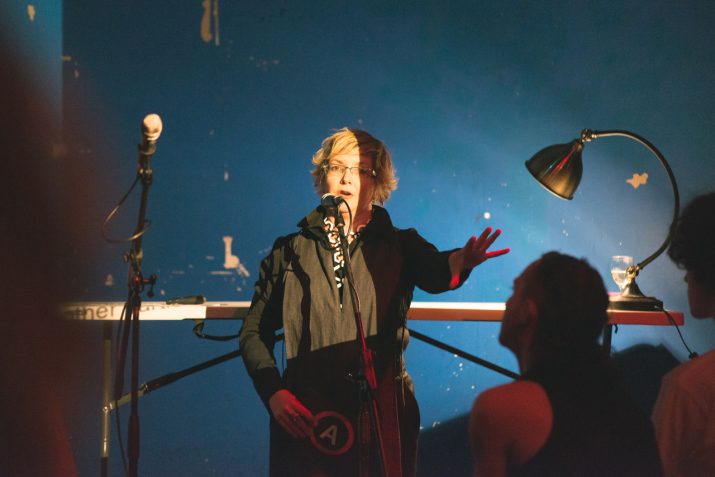
Sara Ramshaw is a Professor of Law and Director of the interdisciplinary graduatate program, CSPT (https://www.uvic.ca/interdisciplinary/cspt/index.php). Her research interests fall broadly in the area of arts-based approaches to law, with a specific focus on the improvisatory arts, especially music, dance and theatre. Although she has been collaborating with academics and sonic artists in Australia and Northern Ireland for several years on the topic of Acoustic Justice, this is her first attempt at soundscape composition.
Mitch Renaud — (Whither) Winter/Wither; Attention & Nostalgia (or: the Listening of Listening)

I will present some tentative probes on nostalgia and attention with an adjacent solo performance on the sympath, a feedback instrument with which I am developing a performance practice that embodies attention and relation. I will take up nostalgia as akin to wintering (in suspending attention, to avoid and/or defer critical spaces of reflection), drawing on examples such as field recordings as a means of documenting the soundscape. Nostalgia opens spectral spaces where medial ghosts of desire occlude what’s there, divorced laterally from relation and holding present what never was (e.g. nature). Having gathered a few examples of nostalgia, I will offer openings of an alternative mode of attending through relation. These fragments and performance will reach towards the listening of listening, a mode of audition in relief of/to/with that hopefully stands out from withered attention.
Mitch Renaud is a sound artist, composer, and curator based in Victoria, BC, on the unceded homelands of the lək̓ʷəŋən (Songhees and Xʷsepsəm nations). Moving between performing with electronics and composition, he is interested in the myriad aspects of relation: whether it’s through feedback systems, co-composition, improvisation, or place-based work.
Mitch performs solo as well as in ongoing collaborations with artists such as Dave Riedstra, Emilie LeBel, and Katelyn Clark. In the fall of 2025, he will begin a PhD at the University of British Columbia with Dylan Robinson.

 seismopoetics